
Switching Costs

As mentioned in my introduction article about moats, there are four different types of economic moat. Aside from cost advantages that create a competitive advantage by putting competitors under pressure with lower prices, wide moats can be created either by network effects or intangible assets. In this article we will look at the fourth competitive advantage, which can create pricing power for companies – switching costs. Many people argue, that switching costs – as well as network effects – seem to be central to the “new economy” information technology industries and might be the most valuable economic moat a company can have.

In the following article, we will provide a definition of switching costs and look at some of the main characteristics. Additionally, we will analyze three main categories of switching costs (split up in eight subcategories).
Definition Switching Costs
A good, short definition of switching costs stems from Farrell and Klemperer: “A consumer faces a switching cost between sellers when an investment specific to his current seller must be duplicated for a new seller.” (p. 1977). Switching costs are the one-time and extra costs a customer is facing when trying to switch to a similar product from another company and therefore costs he would not face when remaining with the first company and its product(s). Switching costs are the negative costs that are associated with the switching process itself, but the costs do not have to occur immediately during or after the switching. These costs arise because in most cases an initial investment has to be duplicated for the new firm while this duplication (and the additional costs) would not have been necessary when staying with the old firm. And if the switching costs (or the perceived switching costs) are higher than the premium one has to pay for the current company’s products, a customer won’t switch. On the other hand, if the premium for the current product and/or the frustration about the product is too high, customers might very well accept the switching costs and switch to another company.
But switching costs are especially powerful because switching costs can create monopolies for companies that would otherwise not be able to reach the status of a monopoly or won’t even be able to differentiate itself from its competitors. Switching costs create ex post monopolies for which firms compete ex ante (see Klemperer). The existence of switching costs also means that history matters as it is more likely for a customer to stick with a company, he already made a purchase from when facing high switching costs. Therefore, the past (the customer’s history) will determine future buying decisions and narrow the (maybe) huge array of possibilities before the initial decision to just one remaining decision (in the worst case of extreme switching costs). When he or she bought a product or service from company A, he or she will more likely make the purchase again from company A (and not company B or C even if the products are cheaper and/or better). Paul Klemperer wrote in this context, that switching costs make products that once were identical or homogenous to heterogeneous products after the initial buying decision due to switching costs.
In case of switching costs, companies also have to stop looking at a single consumer’s needs in a single period or look at single purchases and buying decisions, but look at the single consumer’s needs over time and look at a long string of buying decisions (and therefore constant stream of revenue for the company). Normally, a rational customer would make a rational buying decision every time and purchase the best product. We know such a customer is nonsense, but switching costs are robbing the customer of the chance to make a new decision every time he likes to purchase the product (if he wants to buy from company A, B or C).
Switching costs very often lead to a bargain-then-ripoff-structure (see Klemperer), where the price for the first purchase is rather low and for the following purchases the customer has to pay a higher price (as now switching costs would arise). This becomes clearest when new customers and already locked-in customers are clearly distinguished and can be charged different prices. When prices are individually negotiated it can be a different price for the same product. If a firm has to set a single price to old (already locked-in) and new customers, that price must be a compromise between a high price to exploit current locked-in buyers and a lower price to attract more buyers to lock in and exploit later.
If companies are not able to set a different price for the same product, companies can sometimes profit from selling additional co-products (at higher prices) and the more co-products a customer is buying that support or complement the original product, the higher the switching costs become. In many cases, these companies offer additional maintenance services (depending on the product).
More Information about Switching Costs
When analyzing companies with switching costs, there are a few additional aspects we should look out for. Companies with high switching costs have pricing power. Switching costs are also higher when the product is embedded in a complex structure, in case of cheap products that are essential and when the switching costs are not really visible before making the initial purchase.
Pricing power
Economic moats very often lead to pricing power for the companies (not in every case), but when looking at switching costs the pricing power is very obvious. As switching costs are usually high one-time costs that consumers and customers are trying to avoid, the company is able to increase the price for its product every single year a few percentage points and customers still won’t switch as they are trying to avoid the one-time costs.
Switching costs are higher when the product is embedded in a more complex structure
In some cases, the type of moat I call switching costs is called “embeddedness” as the switching costs are especially powerful when the product or service is embedded in a bigger, more complex structure. The competitive advantage is deriving from the fact, that a product or service can’t be seen as an isolated item one can switch easily, but it is in most cases embedded into something bigger. And switching costs are extremely powerful in case of B2B relationships as businesses usually have more complex structures making the single products more embedded and much more difficult to switch. Individuals usually don’t have huge databases or programs that thousands of employees are using and are trained for. Switching costs become more powerful when dealing with big corporations or institutions, with complex systems or many different individuals using a product or service simultaneously.
Cheap products that are essential
Switching costs are extremely powerful for products that are rather cheap compared to the total costs of goods sold, but have a huge effect on the end product or outcome. Basically, when there is an extreme mismatch between the costs/input on the one side (extremely low) and the output/products on the other side (extremely high), switching costs are extremely effective. We therefore have to look for products with a high benefit/cost ratio when searching for companies with switching costs: We are looking for a product that costs only a few dollars (in case of a very expensive product), but the benefit of the product is extremely high (or to put it differently: the damage of that particular item missing would be immense for the end product). This is especially the case if the small item is responsible for the safety of the product.
Switching costs should be not visible
Switching costs also work if consumers or customers are not aware of the switching costs before making the initial purchase. If customers are aware of the high switching cost and know they will be ripped off by the company over years to come, at least a few customers wouldn’t make the purchase. However, when all similar products have high switching costs themselves and the customer doesn’t have a choice, switching costs can be visible. Switching costs often being invisible from the outside and only become clear after buying and using the product is making our work difficult as well. We are searching for companies with high switching costs but are often not aware what companies and products create high switching costs.
Different types of Switching Costs
There are different classifications of switching costs, but in my opinion the best classification stems from Thomas A. Burnham, Judy K. Frels and Vijay Mahajan in the 2003 paper “Consumer Switching Costs: A Typology, Antecedents, and Consequences” and the three authors separate eight different types of switching costs which can be classified in three categories:
Procedural Switching Costs: Consisting of economic risk, evaluation, learning and set-up costs, this type of switching costs primarily involves the expenditure of time and effort.
Financial Switching Costs: Consisting of benefits loss and financial-loss costs, this type of switching costs involves the loss of financially quantifiably resources.
Relational Switching Costs: Consisting of personal-relationship loss and brand relationship loss costs, this type of switching cost involves psychological or emotional discomfort due to the loss of identity and the breaking of bonds.
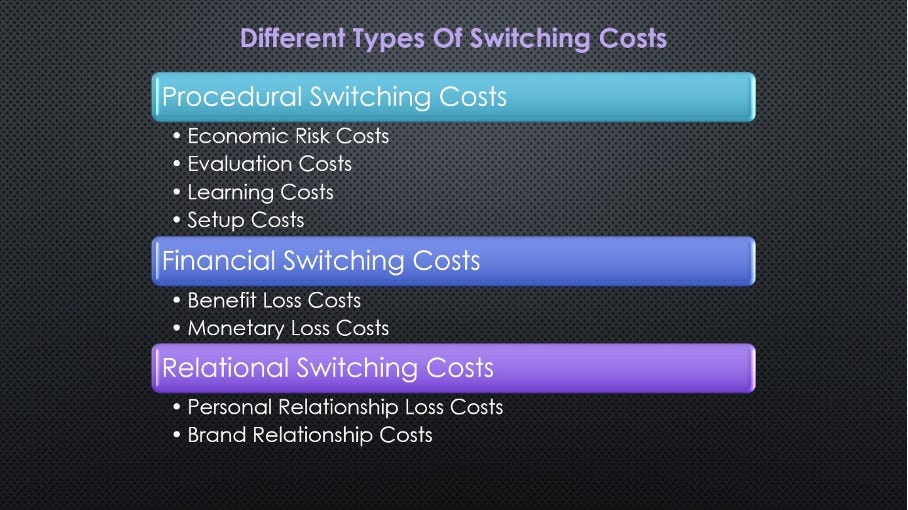
In the following section we will look at the eight different types of switching costs individually.
Not all eight switching costs are important for stock analysts and investors as not all eight can be found in companies listed on stock exchanges. Nevertheless, we will present all eight in a short overview.
Economic Risk Costs are the costs of accepting uncertainty with the potential for negative outcome when adopting a new provider about which the customer has insufficient (or at least very little) information. In this case, the switching costs are also the financial expenses, but especially the time that has to be invested before finding a similar product or service. And even after finding a similar product and having invested all the time and effort, the economic risk still exists because the company might only find out after time if the product is of similar quality.
Example: Precision Castparts (acquired by Berkshire Hathaway)
Evaluation Costs are the time and effort costs associated with the search and analysis needed to make a switching decision. Time and effort are associated with collecting the information needed to evaluate potential alternative providers and the products and services. Mental effort is required to restructure and analyze available information in order to arrive at an informed decision.
Learning Costs are the time and effort costs of acquiring new skills or know-how in order to use a new product or service effectively. The time spent on learning is often provider-specific, meaning new investments must be made to adapt to a new provider and the learning investments already made with the old provider are useless for the new provider. These learning costs are especially high when the learning curve is very steep and it takes a long time to learn, but learnings costs are also high when the learning curve for the individual is not so steep, but a company has to train thousands of people creating immense combined learnings costs when switching to a new product. These learning costs can arise when dealing with complex software programs or when it is difficult to operate a certain machine (airplanes or laboratory equipment).
Examples: Adobe, Microsoft Office (as many employers are trained on the program)
Setup Costs are the time and effort costs associated with the process of initiating a relationship with a new provider or setting up a new product for initial use. Setup costs for services are dominated by the information exchange needed for a new provider to reduce its selling risks and understand the customers’ specific needs. Setup costs can arise when a company is introducing a new database and has to put in a lot of data, has to reorganize data, copy documents and so forth. As the switching process is usually keeping many staff members very busy it takes a lot of time and working hours.
Example: Accenture, SAP, Oracle, banks
Benefit loss costs are those switching costs that arise because the customer will lose some kind of benefit, he has as customer of the current company but won’t have with any other company. These are contractual linkages that create economic benefits for staying with the current firm like some forms of discounts or additional services, that won’t be granted to new customers right away.
Examples: Frequent-flyer programs of travel companies (air travel)
Monetary loss costs are onetime financial costs that arise by switching providers, but wouldn’t arise when staying with the original company. These costs can arise because the switching process makes one-time expenditures such as initiation fees or setup costs necessary or because some new products have to be bought. Additionally, monetary loss costs can arise because some “co-assets” or some other transaction-specific assets have to be bought again because of missing compatibility. The necessity of buying an asset again that wouldn’t have to be bought without the switching is causing a monetary loss.
Examples: Apple, Nespresso
Personal relationship loss costs are the affective losses associated with breaking the bonds of identification that have been formed with the people with whom the customer interacts. Consumers’ familiarity with incumbent provider employees creates a level of comfort that is not immediately available with a new provider. This can be the case for consulting firms or companies that do back-office processing for other companies – aside from long-lasting contracts they also might form personal relationships and a bond of trust one doesn’t give up easily (happens for example when switching a doctor, that not only has a lot of knowledge about the patient, but there also might have formed a close personal relationship and a bond of trust).
Examples: Accenture, Fiserv
Brand relationship costs are the effective losses associated with breaking the bonds of identification that have been formed with the brand or company with which a customer has associated. Consumers often draw meaning from owning products of a certain brand but in my opinion, we are not really talking about switching costs, but rather about the competitive advantage that stems from an intangible asset (the brand).
Conclusion
Switching costs are one of the four sources of competitive advantage for a company and can in some cases create an extremely powerful economic moat. There are three main forms of switching costs: switching could require a lot of necessary time and effort (procedural switching costs), switching could lead to additional financial costs (financial switching costs) or switching could lead to emotional and psychological discomfort (relational switching costs). In every single case, the costs for switching are so high that one has to question the benefits of the switching process. A company can maximize its switching costs, when a product is cheap but essential, when switching costs are not visible beforehand and when the product is embedded in a complex structure. In these cases, companies often have pricing power.